When Should You Hire a CFO?

One of the most common questions founders ask as their business grows is simple:

“Do we need a CFO?”

It’s a reasonable question, especially as a business grows it gets more complex. Revenue is growing, the team is expanding, and decisions carry more weight. At some point, the instinct is to bring in a senior finance hire to “professionalise” things.

But in many cases, that’s solving the wrong problem.

What most businesses actually need at this stage isn’t a CFO. They need a finance function that lays the foundation – reliable reporting, clear financial visibility, and forward-looking insight to support decision-making.

A CFO can absolutely provide that, but only when they’re supported by the right underlying team and processes. In many businesses, that foundation isn’t in place yet.

That’s where an external finance partner can be effective – providing both the day-to-day finance support and senior oversight needed to build a functioning finance setup, before it makes sense to hire a full-time CFO.


When Growth Outpaces Finance

In the early days, finance tends to be handled in an informal way. The founder is close to the numbers, there may be a bookkeeper or a junior hire, and reporting is relatively straightforward.

That works - until it doesn’t.

As the business grows, things start to change. Cash flow becomes less predictable. Investors / potential investors require more detailed reporting. Decisions need to be made based on what’s likely to happen next, not just what’s already happened.

This is usually the point where finance starts to feel stretched. Numbers take longer to produce. Visibility isn’t quite there. And there’s a growing sense that the business is moving faster than the financial insight behind it.

That’s often when the idea of hiring a CFO comes up.


Why a CFO Isn’t Always the Answer

Bringing in a CFO can feel like the natural next step. It signals maturity and experience, and in the right context, it can be a very strong move.

But if the underlying finance function isn’t in place, a CFO can quickly become the wrong solution.

In practice, what often happens is this: a senior hire is brought in with a strategic mandate, but they end up spending a significant amount of time dealing with day-to-day issues - fixing reporting, chasing numbers, laborious data entry, or building basic processes that should already exist.

The result is that the business doesn’t get the full benefit of their experience. And the CFO, instead of acting as a strategic partner, becomes a workaround for gaps elsewhere in the Finance Function.


The Real Issue: Gaps in the Finance Function

A finance function isn’t just centred on one person. It’s a combination of activities that need to work together.

At one end, there’s the operational side - making sure invoices are raised, cash is tracked, and the basics are done properly. Then there’s reporting and control - producing accurate, timely numbers that the business can rely on. Beyond that, there’s planning and analysis - understanding what’s coming next, modelling different scenarios, and supporting decisions.

In many growing businesses, one or more of these areas is either underdeveloped or missing entirely.

That’s when issues start to show up. Decisions get made without full visibility. Cash pressures appear later than they should. Fundraising becomes more reactive than planned.

None of this is unusual - but it does point to a structural problem, not just a resourcing one.


A More Effective Way to Think About It

Rather than asking whether you need a CFO, it’s more useful to step back and ask a different question:

Do we have the financial capability to support the next stage of growth?

That shifts the focus from hiring a specific role to understanding what the business actually needs.

In some cases, that might mean strengthening the basics - improving reporting, tightening processes, or getting better visibility on cash. In others, it might mean introducing more forward-looking analysis, so decisions are based on clear scenarios rather than instinct.

For many businesses, the answer isn’t to build a full in-house team immediately. Instead, it’s about accessing the right level of support at the right time - combining operational capability with more senior financial input as needed.

That approach allows the finance function to evolve alongside the business, rather than trying to leap ahead of it.


What Good Looks Like in Practice

When the finance function is working well, it doesn’t draw attention to itself - but its impact is clear.

There’s a shared understanding of the numbers across the leadership team. Cash is visible, not guessed. Decisions are made with a clear view of the trade-offs involved.

Importantly, the conversation shifts. Instead of looking backwards and asking what happened, the focus turns to what’s coming next, and what the business should do about it.

That’s when finance starts to become genuinely valuable.


So When Does a CFO Make Sense?

There is a point where a full-time CFO is the right move.

Typically, that’s when the business has reached a level of scale and complexity where strategic financial leadership is needed on an ongoing basis. By that stage, the foundations are already in place, and the CFO can focus on driving the business forward rather than fixing what sits beneath it.

Bringing someone in at that point tends to work well - because the role is clear, and the business is ready for it.


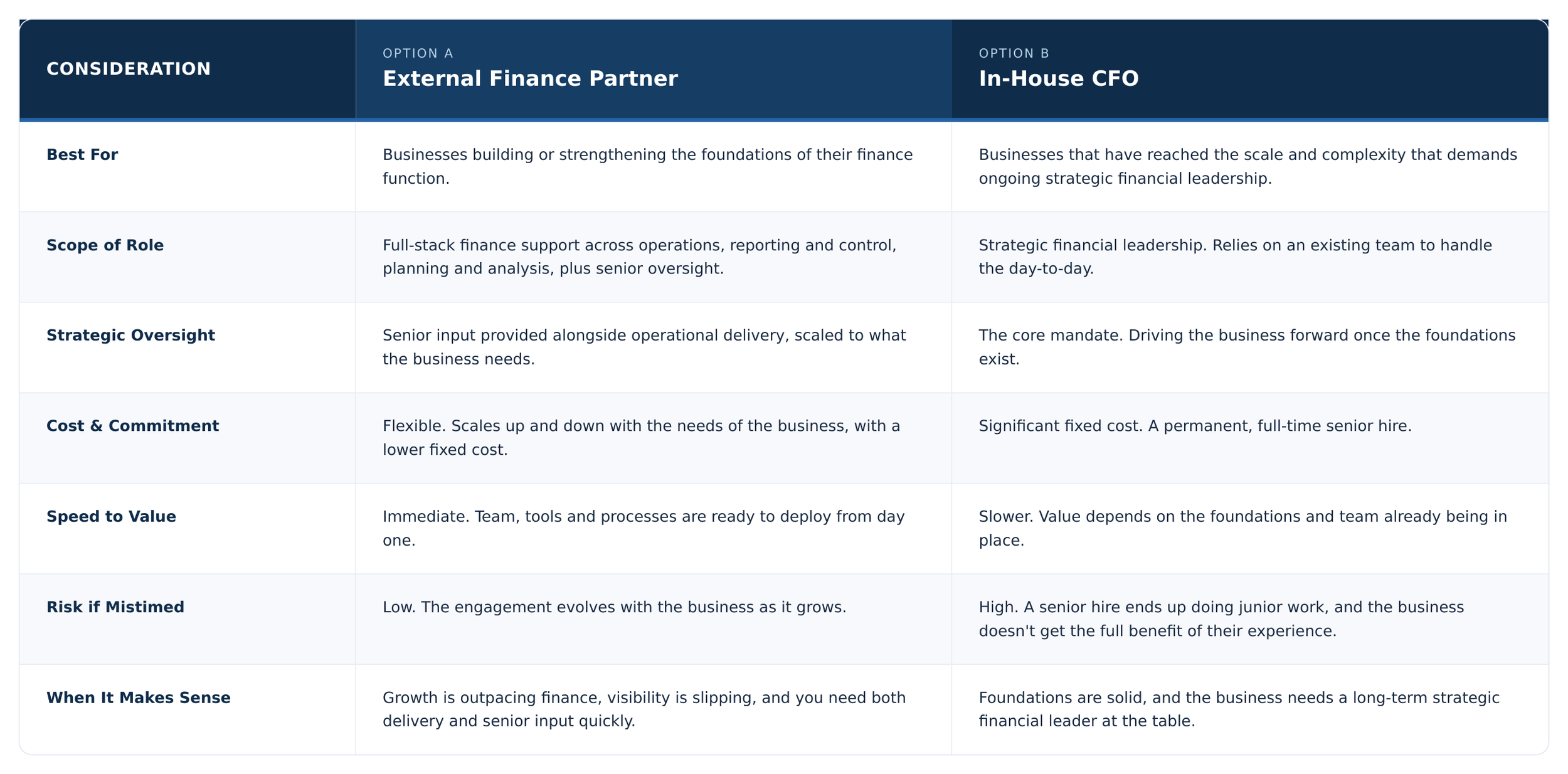
Summary: External Finance Partner vs In-House CFO

About the Author

Matt Gilmour is the Founder and Director of Finex Advisory, leading our team in delivering a full suite of services to high-growth and founder-led businesses.

A Chartered Accountant (ACA) and entrepreneur, Matt brings extensive experience across corporate finance, including M&A, due diligence, and business building.

Before founding Finex, he held senior roles at BDO, PwC, and Silverpeak, advising small and mid-sized businesses across corporate finance, accounting, and consulting.

Matt has worked closely with founders and management teams to improve financial performance, drive profitability, and prepare businesses for growth, investment, and exit.

His approach combines the technical precision of a CFO with the strategic perspective of an investor, helping clients turn financial data into meaningful business outcomes.

Previous
Previous

Finex Advisory shortlisted for 2026 North West Rainmaker Awards

Next
Next

How founders should think about taking Private Equity investment.